
Find Intrinsic Value: The 2026 AI Bubble Security Analysis Guide
Master Warren Buffett’s Security Analysis to find undervalued stocks today.
INVESTING
4/15/20263 min read
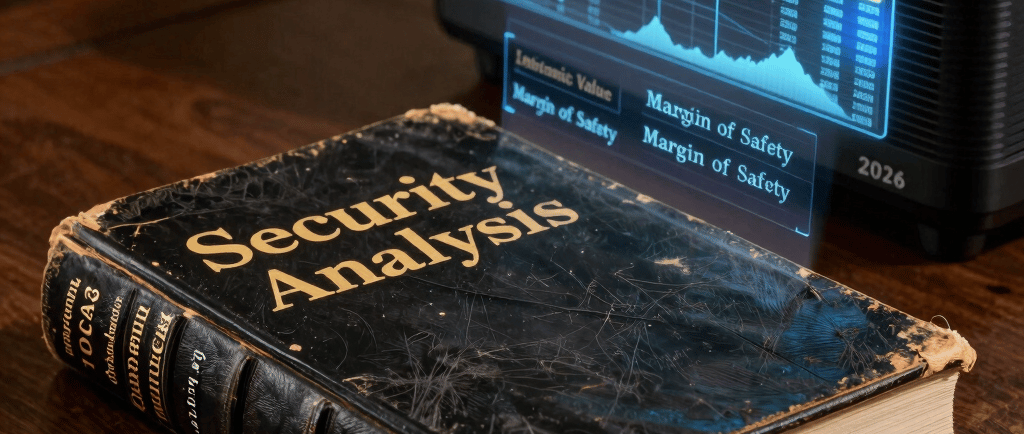
How to Find Intrinsic Value in an AI Bubble: The 2026 Security Analysis Guide
In July 1934, while the world was reeling from the economic debris of the Great Depression, a 766-page textbook landed on the desks of Wall Street with a definitive thud. This volume, Security Analysis by Benjamin Graham and David Dodd, became the "bible of value investing." It didn’t just change the way people picked stocks; it transformed global finance.
Today, as we navigate the complexities of 2026—from AI-driven market spikes to decentralized finance—the greatest financial minds, from Warren Buffett to Seth Klarman, still treat these pages as a sacred roadmap. If the modern market feels like a chaotic casino, it is time to put down the dice and pick up the magnifying glass. This is a scientific method for maximizing skill and minimizing the influence of luck.
The Viewpoint of Calamity: Risk Management First
To understand the power of this book, you must understand the era that birthed it. Graham and Dodd wrote when the Dow had lost 87% of its value. Consequently, they approached the market from the "viewpoint of calamity."
This mindset is the ultimate gift to the modern investor. Most people enter the 2026 market focusing on "moon shots." Graham and Dodd teach you to focus on avoiding serious loss, the absolute precondition for sustaining a high compound rate of growth. In their world, a high-grade investment is not one that promises a jackpot, but one that survives the "highly improbable."
Investment vs. Speculation: The 2026 Reality Check
The heart of the Graham and Dodd philosophy lies in a single definition: An investment operation is one which, upon thorough analysis, promises safety of principal and a satisfactory return. Anything else is speculation.
Most of what occurs on modern trading apps today—chasing AI hype or meme-coins—is not investing; it is unintelligent speculation. An analyst’s investment is not a gamble on a stock price going up; it is an operation justified by both qualitative data and quantitative facts.
Calculating Intrinsic Value in a Volatile Market
If the market price is just a number on a screen, what is its intrinsic value? Graham and Dodd define it as the value justified by facts: assets, earnings, dividends, and definite prospects.
They warn that intrinsic value isn’t a single, pinpoint number. Think of it like this: you can tell a person is "heavier than they should be" without knowing their exact weight down to the ounce. The goal of security analysis is to establish that the value is adequate to justify the purchase. You are looking for the "gap" between the truth and the ticker.
Mr. Market: The Voting Machine vs. The Weighing Machine
In the short run, the market is a voting machine, registering choices based on emotion, fear, and "FOMO." But in the long run, it is a weighing machine.
The intelligent investor realizes that market prices are frequently irrational. The analyst’s job is to remain stalwart in the face of bad news. While the crowd is busy capitalizing on "conjectural future prospects," the analyst is searching for values supported by the balance sheet.
Margin of Safety: Protecting Your Portfolio from Market Crashes
The phrase "Margin of Safety" is the single most important concept in finance. It is your room for error, bad luck, or economic shifts.
The aim of the analyst is to pay a good deal less than intrinsic value. Just as you wouldn’t cross a bridge carrying the maximum allowable weight, you shouldn’t buy a stock at its full estimated value. By purchasing at a discount—the "dollar for 50 cents" principle—you create a buffer that protects you if your analysis is slightly off.
The Architecture of the Balance Sheet
While 2026 analysts are often obsessed with "projected earnings," Graham and Dodd remind us that earnings can be an accounting fiction. Instead, look at the balance sheet. Look for "net-current-asset value"—what a company is worth if it shut its doors today. While these "bargains" are rarer in a high-tech economy, the principle remains: know what you are getting in terms of tangible resources.
Bond Selection: The "Negative Art"
Graham and Dodd describe bond selection as a negative art. It is a process of exclusion. When you buy a bond, you are surrendering profit potential for safety. Therefore, you must be exacting. A bond that isn't safe during a recession is not a high-grade investment, regardless of a high interest rate.
Neuroeconomics and the Psychology of Wealth
Though written decades ago, Security Analysis aligns with modern neuroeconomics. We now know the brain’s nucleus accumbens fires more intensely when expecting a gain than when receiving one. This biological "prediction addiction" explains why speculators are seduced by growth hype, often ignoring the risk of overpaying.
Conclusion: Your Financial Constitution
Just as the founders of a nation write a constitution to guide them through change, Graham and Dodd wrote a treatise for the investment world. It is an analytical anchor that keeps you focused on long-term results rather than your daily trading ledger.
Stop being the "patsy" in the Wall Street poker game. Master the timeless wisdom of Security Analysis. As the authors quoted from Horace: "Many shall be restored that now are fallen, and many shall fall that now are in honor." Ensure that you are among those who rise.