
Master Your Identity: 1% Daily Growth Is The Secret
Redesign your life with small habits and proven scientific systems.
SELF-MASTERY
4/11/20265 min read
The Architecture of Transformation: Why Your Systems, Not Your Goals, Determine Your Destiny
We have all been there. The clock strikes midnight on New Year’s Eve, and we are filled with a sudden, electric surge of motivation. We resolve to finally lose the weight, write the book, or master that language. We set massive goals and imagine a total metamorphosis. But by the second week of February, the gym is empty, the notebook is blank, and we are back to our old patterns, feeling like a failure.
I used to think that my inability to change was a character flaw. I thought I lacked willpower. But after diving deep into the principles of James Clear’s Atomic Habits, I realized I was looking at the problem entirely wrong. Change does not come from intensity; it comes from consistency. It does not come from big leaps; it comes from small steps repeated over time.
If you feel stuck, it is not because you are weak. It is because your systems are designed to produce the results you are currently getting. To change your life, you have to change the design.
The Surprising Math of 1%
Most people think that to get 37 times better at something, you need a radical transformation. In reality, the math is much simpler: you just need to get 1% better every single day.
Think about the British Cycling team. For a century, they were a disaster—so bad that manufacturers wouldn’t even sell them bikes for fear of brand damage. Then came Dave Brailsford and his philosophy of the aggregation of marginal gains. He didn’t look for one big fix. Instead, he improved everything by 1%: better tires, heated over shorts for muscle temperature, even teaching riders how to wash their hands properly to avoid colds.
The result? Within five years, they dominated the Olympics. This is the power of compound interest applied to self-improvement. Your habits are the interest on your future self.
Why You Haven't Seen Results (Yet)
The hardest part of building a new habit is what I call the Valley of Disappointment. You work out for two weeks and don’t look different. You study for a month and still can’t speak the language. This is where most people quit.
But habits are like bamboo. For five years, bamboo builds a massive root system underground. To an observer, nothing is happening. Then, in six weeks, it shoots up ninety feet. Your results aren’t missing; they are stored. You are building roots. The breakthrough is coming, but only if you stay consistent long enough to cross the plateau of latent potential.
Identity-Based Habits: Stop Trying, Start Becoming
This is the most profound shift I’ve made in my own life. Most of us focus on outcomes (losing weight) or processes (going to the gym). But the deepest layer of change is identity.
Imagine two people trying to quit smoking. When offered a cigarette, the first says, No thanks, I’m trying to quit. The second says, No thanks, I’m not a smoker. The difference is everything. The first person still identifies as a smoker trying to be something else. The second has redefined who they are.
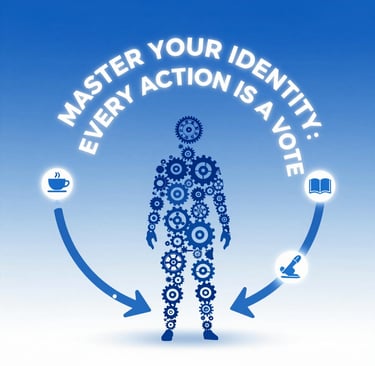
Every action you take is a vote for the person you want to become. You don’t need to be perfect; you just need to win the majority of the votes. When you work out, you aren’t just burning calories; you are casting a vote for the identity of an athlete. When you write one paragraph, you are casting a vote for the identity of a writer.
The goal isn’t to read a book; the goal is to become a reader.
The Four Laws of Behavior Change
To hack your brain’s natural loops, you need to understand the four stages of a habit: cue, craving, response, and reward.
1. Make It Obvious
We are often unaware of our own habits. I recommend starting with a Habit Scorecard. Write down everything you do from the moment you wake up. Don't judge it; just see it.
Once you see the patterns, use Habit Stacking. The formula is: After I [Current Habit], I will [New Habit].
After I pour my morning coffee, I will meditate for one minute.
After I sit down at my desk, I will write one sentence.
You are borrowing the neural pathway of an old habit to trigger a new one.
2. Make It Attractive
Our brains run on dopamine, which is the chemical of anticipation. We are more motivated by the promise of a reward than the reward itself.
Use Temptation Bundling. Only allow yourself to do something you want to do while doing something you need to do. I only listen to my favorite true-crime podcast while I’m doing the dishes. Suddenly, the dishes don't seem so bad.
3. Make It Easy
We are biologically wired to follow the path of least resistance. This isn't laziness; it's efficiency.
If you want to exercise, set your clothes out the night before. If you want to eat healthier, put fruit on the counter and hide the junk food in the basement. Environment design is the invisible hand that shapes human behavior.
The most powerful tool here is the Two-Minute Rule. When you start a new habit, it should take less than two minutes.
Read before bed becomes Read one page.
Run three miles becomes Put on my running shoes.
You have to standardize before you can optimize. You can't improve a habit that doesn't exist. Master the art of showing up.
4. Make It Satisfying
The problem with good habits is that the cost is in the present and the reward is in the future. Bad habits are the opposite: the reward is now (the sugar hit), and the cost is later (the health issues).
To make a good habit stick, you need an immediate reward. Track your habits on a calendar and mark a big X for every successful day. There is nothing more satisfying than visual progress. Your goal is simple: Don’t break the chain.
The Professional vs. The Amateur
The greatest threat to success isn't failure; it's boredom. Once a habit becomes automatic, it becomes routine, and routine can be boring.
The Goldilocks Rule states that we are most motivated when we work on tasks right at the edge of our ability—not too easy, not too hard. To keep growing, you have to slightly increase the challenge as you get better.
But more importantly, you must learn to fall in love with the boredom. Amateurs only work when they feel inspired. Professionals show up even when they don’t. They understand that the system is the prize.
Final Thoughts: Be the Architect, Not the Victim
You do not rise to the level of your goals; you fall to the level of your systems.
Stop looking for the one big move that will change everything. Instead, look for the 1%. Design your environment so the right choice is the easy choice. Align your habits with your identity.
The breakthrough isn't a single event. It's the result of a thousand small decisions made on ordinary Tuesdays. Start today. Take two minutes. Cast one vote.
Your future self is waiting.