Stop Chasing Gains: The Lazy Way to Retirement Wealth
Discover why doing less is the ultimate strategy for success.
INVESTINGSTRATEGY
4/4/20265 min read

Most people feel a surge of anxiety when they hear the word investing. They immediately picture flickering green and red charts, screaming Wall Street traders, and complex mathematical formulas that seem designed to keep the average person out. They believe that unless they are financial experts with triple-monitor setups, they are destined to make uncertain choices or, worse, lose everything.
But here is the truth I discovered: this confusion doesn’t come from investing itself. It comes from the noise. We are bombarded by too much information, too many conflicting opinions, and a 24-hour news cycle that profits from your fear. Every day, someone is telling you what to buy or sell. When markets fall, fear rises; when they soar, greed takes over.
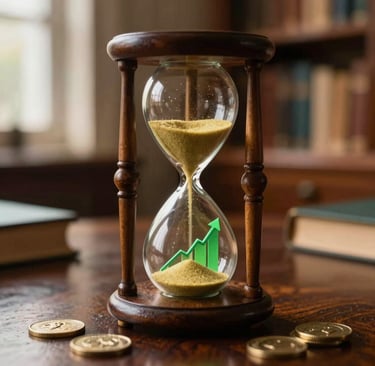
In the middle of this chaos, a simple, quiet truth gets lost. Investing is not a game of guessing or reacting. At its core, it is a steady, almost boring process of putting money into something valuable and giving it the one thing most people lack: time.
As I sat down to review the principles of long-term wealth, one quote from Warren Buffett hit me like a lightning bolt: The stock market is designed to transfer money from the active to the patient. This single idea removes the fog. Success doesn't come from doing more; it comes from doing less, but doing it right.
What Does Investing Actually Mean?
Before you can build a portfolio, you have to strip away the jargon. Investing is not about luck or hitting a jackpot. It is about ownership. When you buy a stock, you aren't just buying a ticker symbol or a digital number; you are buying a piece of a real business that makes products, provides services, and earns profits.
If that business grows, your investment grows. If you understand this, your focus shifts from price to value. Most people obsess over the daily price. They feel happy when it’s up and terrified when it’s down. But price is just a reflection of current opinion. Value is the reality of the business.
Benjamin Graham, the mentor to the world’s greatest investors, famously said that in the short run, the market is a voting machine (driven by popularity), but in the long run, it is a weighing machine (driven by actual substance). When you start thinking like an owner instead of a trader, the daily fluctuations stop being scary. They become irrelevant.
The Great Destroyer: The Desire for Certainty
Why do we still feel confused even when we know the basics? Because humans crave certainty. We want a guarantee of what will happen tomorrow. Since the market is inherently unpredictable in the short term, we try to compensate by consuming more news, reading more reports, and listening to more "experts."
But more information does not equal better results. In fact, it usually leads to over-complication. We search for the "perfect" plan and, in doing so, abandon a good plan. Peter Lynch once noted that if you spend more than a few minutes a year on economic forecasts, you’ve wasted your time. The noise of the world is designed to make you feel like you’re missing something, which triggers envy. And envy is the enemy of a clear strategy.
The Hidden Power of Simplicity
In a world that celebrates complexity, simplicity is a superpower. A complex strategy is hard to follow, hard to trust, and easy to abandon when things get tough. A simple strategy—investing regularly in strong assets and holding them for decades—is easy to repeat. And in the world of money, repetition is the key to the kingdom.
Simplicity brings peace of mind. When you aren't checking the markets every hour, you free up your mental energy for things that actually matter in your life. Remember, investing should support your life, not control it.
Time: Your Greatest Ally
The biggest mistake I see (and have made myself) is short-term thinking. When you look at things day-to-day, everything is a crisis. When you look at things decade-to-decade, the trajectory is clear. Time reduces uncertainty. Patterns emerge. Value becomes visible.
This is where the "Eighth Wonder of the World" comes in: Compounding. Compounding is a patient teacher. It rewards those who stay and punishes those who leave. At first, the growth feels agonizingly slow. You might see very little change for years. But eventually, your returns start generating their own returns. The growth becomes exponential. However, this only works if you do not interrupt the process. Every time you panic-sell or "take a break" from the market, you reset the clock on your wealth.
The Three Pillars of the Wealthy Mindset
To move from confusion to clarity, I’ve adopted three non-negotiable pillars:
Patience over Activity: Doing nothing is often the most productive thing you can do. It takes character to sit still while everyone else is rushing to the exits.
Emotional Control: Your behavior matters more than your IQ. If you can stay rational while the world is panicking, you have an unfair advantage.
Consistency: Success is the result of small actions done repeatedly. Don't wait for the "perfect" time to start. The best time was twenty years ago; the second best time is today.
Managing Risk vs. Avoiding Risk
Many people stay away from the markets because they are afraid of risk. But staying away has its own risk: the certainty that your money will lose purchasing power to inflation.
The goal isn’t to avoid risk, but to manage it. You do this through understanding (don’t buy what you can’t explain) and diversification (don’t put all your eggs in one basket). Diversification isn't about being random; it's about having a margin of safety so that one bad event doesn't wipe you out.
Building Your Personal Strategy
Your strategy must be personal. What works for a billionaire might not work for you. You need to know your own risk tolerance. If a 10% drop in your portfolio makes you lose sleep, your strategy is too aggressive. Be honest with yourself. A strategy you can stick with through a crash is infinitely better than a "perfect" strategy you abandon at the first sign of trouble.
Set your own rules. Decide in advance how much you will invest and how you will react when the market inevitably dips. Rules remove the need for willpower. When the world gets loud, you don't have to think—you just follow your rules.
The Beauty of Doing Less
We are trained to believe that "hard work" equals "more activity." In investing, the hardest work is the internal struggle to remain still.
I have learned that most of my wealth will come from a small handful of great decisions, not from a thousand small trades. Quality over quantity. By doing less, you reduce your costs, you reduce your mistakes, and you allow the natural growth of the world's best businesses to do the heavy lifting for you.
Final Thoughts: Trust the Process
If you have built a simple plan, understood your risks, and committed to a long-term view, the final step is trust. Not blind luck, but trust in the historical reality that quality rises over time.
There will be setbacks. There will be moments where you feel like a fool for holding on while others are "making a killing" in the latest trend. But remember: those trends are the noise. Your plan is the signal.
Stop chasing the "next big thing." Stop trying to time the bottom. Simplify your approach. Ignore the news. Trust the process. The path to wealth is not a sprint; it’s a long, quiet walk in the right direction. And for those with the discipline to stay on the path, the destination is guaranteed.