
Why 95% of Traders Fail: The Psychology of Losing Money
Stop chasing indicators and start mastering the war inside your head.
INVESTING
3/26/20264 min read
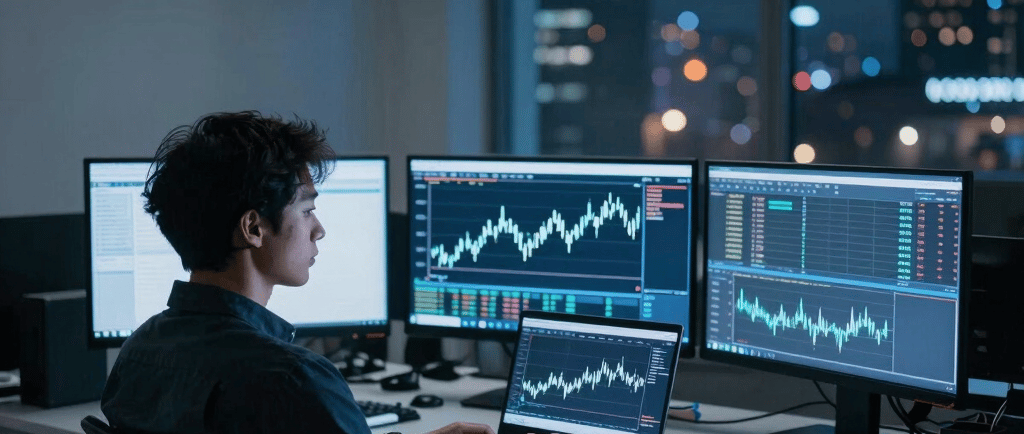

Imagine sitting in front of your monitors, pulse racing, as jagged green and red lines flicker across the screen. You’ve bought the courses, you’ve memorized the golden cross, and you’ve stayed up until 3:00 AM chasing the London open, convinced that you are just one secret indicator away from a Mediterranean villa.
Yet, the more you trade, the more you seem to lose. It isn’t just your balance that’s shrinking; it’s your sanity. You feel like a gambler at a rigged table, blaming the market makers, the news, or your internet connection for your frustrations. But here is the bucket of ice water to your face: The market isn’t your problem. Your belief system is.
To join the elite 5% who actually take money out of the market, you must systematically destroy the comfortable illusions you’ve been telling yourself. This is the reality of the psychological traps that keep most traders broke.
The Lethal Allure of Fast
The most dangerous lie you can believe is the myth of quick money. You likely entered the markets because you want freedom, and you want it by Friday. This sense of urgency is a slow-acting poison. When you trade with urgency, you aren't planning; you are reacting.
Think about the last time you saw a price spike. Did you feel that physical jolt of adrenaline? Did you hit buy because you were terrified of missing out? That urgency creates fatal mistakes. The market does not reward your speed; it rewards your control. As Benjamin Graham famously noted, you should act consistently as an investor and not as a speculator. The moment you treat the market as a shortcut to wealth, you’ve already lost. Real wealth is a tree that must be planted and protected for years, not a lottery ticket you scratch off every morning.
The Perfection Trap
You might believe that professional traders are wizards who never see a red day. You might feel that if you have a loss, you have failed personally. This myth of always winning is exactly what leads you to revenge trade—that desperate act of doubling down after a loss just to get it back.
In reality, loss is an expense, not a failure. Think of a retail store; they have to pay rent, electricity, and staff. Those are expenses. In your trading, a loss is simply the cost of doing business. The difference between a winner and a loser isn't the number of wins; it’s the management of the losses. Professionals accept losses like stoic monks, while you might find yourself holding onto losing trades, praying for a bounce that never comes. As George Soros said, it isn’t whether you are right or wrong that matters, but how much you make when you are right and how much you lose when you are wrong.
The Magic Indicator Fallacy
Look at your charts right now. Can you even see the price? If you have RSI, MACD, Bollinger Bands, and Ichimoku Clouds layered on top of each other, you are falling for a classic trap. You think more tools mean more certainty.
You are wrong. Indicators are just reflections of price; they are historical data processed through a lens. They don't predict the future; they lag behind it. When you rely on five different indicators to confirm a trade, the move is usually over by the time they all align. Complexity creates hesitation.
You must learn that simplicity is the ultimate sophistication. A clean chart and a clear mind are worth more than a thousand expensive plugins. Price itself is the only truth. Everything else is secondary noise. When you strip away the clutter, you finally start to see the market’s actual behavior.
The Myth of More is Better
There is a psychological trap that tells you more action equals more profit. In a 9-to-5 job, working more hours usually means more pay. In trading, the opposite is often true.
If you find yourself overtrading out of pure boredom, you are gambling. If the market is sideways and you force a trade just to feel productive, you are failing. Trading isn't about quantity; it’s about precision. Every trade you take exposes your capital to risk. A skilled trader is like a hunter; they don’t fire at every rustle in the bushes. They wait, sometimes for days, for the perfect shot. As Jesse Livermore famously said, "It never was my thinking that made the big money for me. It always was my sitting."
Capital Doesn't Grant Skill
You’ve probably told yourself, "I’d be successful if I just had a $100,000 account." This is perhaps the greatest lie of all. If you cannot manage a $1,000 account with discipline, a $100,000 account will only allow you to lose more money faster.
A large account actually increases your emotional pressure. Starting small is a blessing because it allows you to make mistakes where the tuition is cheap. You must build the muscle of discipline first. Money follows skill; skill never follows money.
The Final Transformation: Your Mindset
The bridge between a struggling trader and a professional isn't a strategy; it’s mindset. You have to reach a point of total detachment. You must be able to lose a trade and feel absolutely nothing—no anger, no sadness, no urge to punch your monitor.
This requires a total shift in your identity. You aren't a trader looking for a win; you are a risk manager following a process. You must be humble because the market is a giant that doesn't care about your ego. You must be resilient because you will face drawdowns that make you want to quit.
Conclusion: The Journey Inward
Trading is the ultimate mirror. It reveals every flaw in your character—your greed, your impatience, and your inability to follow rules. To win at the charts, you first have to win the war inside your head.
Stop looking for the holy grail strategy. It doesn't exist. Instead, start looking at your own behavior. Are you chasing quick money, or are you building lasting wealth? Are you reacting to the crowd, or are you responding to your plan?
The moment you let go of the illusions, the market stops being a monster and starts being a playground of opportunity. It isn't easy, but it is the most rewarding journey you will ever take.